Posts

Darling Of The Day

I listened to a new musical the other day. Or rather, a half-century old musical, but new to me. Darling Of The Day , by the somewhat unexpected team of E.Y. Harburg and Jule Styne, ran for a month on Broadway in 1968, and since then has more or less faded into obscurity with the occasional attempts to revive it  generally being met with indifference. And after listening to it and studying a bit, I can see why. It's not that great. It's not bad. It's just sort of fine. But I still want to talk about it. I was trying to think of a good reason to talk about it. Then I remembered that this is my blog, and I can just talk about things if I want. So here's a write-up of Darling Of The Day . (Cast album available on  Spotify  and  Youtube  and probably other places too.) The story, in a nutshell, is about Priam Farrl, a famous painter played by Vincent Price. He is tired of being a famous painter. One day his butler dies. Vincent Price decides to fake his deat...

A Historically Informed "Echad Mi Yodea"

Image
Every year at Passover, my family, at the end of the seder, sings the three traditional songs that accompany it. Or we attempt to at any rate. We do a decent job with "Chad Gadya," for which we all basically agree on the tune. And we manage to stumble through "Adir Hu" alright too, as we generally agree on the lack  of tune. But "Echad Mi Yodea" gives us particular trouble, and we end up going back and forth between a couple of "tunes" and eventually force our way through the thirteen ever-lengthening verses. It's a sort of Jewish "The Twelve Days Of Christmas," but worse because it goes to thirteen. This year I decided to do some research and settle this matter once and for all. I found some work done by acclaimed Jewish musicologist Cantor Yokannan Ze'ev in the eighties in conjunction with Marshall College. The study, directed by Rabbi Sholom ben Arnold, and conducted in Egypt by Doctor Henry Jones Jr. was focused on archeo...

An Open Letter to Charlotte Jones, David Zippel, and Andrew Lloyd Webber

A revival of the 2004 musical The Woman In White  (based on the novel by Wilkie Collins) concluded its revival run in London to generally lukewarm reviews. Better than the original production, but still not great. One of the reviews pointed out that by shortening the already-condensed show into two hours, it leaves little room for character development while also trying to cram in all that plot. Other common complaints were that Andrew Lloyd Webber's score does not coalesce, and that the drama is muddled. This makes sense. The Woman In White is a gothic thriller that takes at least a half-hour to give a sensible synopsis of. This is not going to be one of your pleasant small-theater murder mystery musicals that can be done by ten in the evening. At the same time, many of the revisions made (at least, according to reviews -- I'm not in London) seem to be in the right direction. But much more can be done. So here's an open letter to Charlotte Jones, Andrew Lloyd Webber, and...

Babylonian Captivity

I don't understand why the character of Idreno in Semiramide  exists. I mean, I get why  he exists. Rossini needed to write a starring role for whatever tenor. Probably that's the reason, or something like that. But surely he could have been given some bearing on the actual plot? Idreno's role is essentially that of one of the extra suitors in any fairy tale about a princess who has to marry one of three people, and they go in order to face some sort of riddle or challenge, and only the hero of the story will succeed and win the princess' hand. Arsace is the hero. Idreno is one of the other guys. Is it a problem that he exists? Not especially. Rule of three more or less dictates that someone  has to be there, and it may as well be a tenor. What bothers me more is that the opera spends half an hour and two major arias on him. Semiramide herself only has one solo aria. If you cut Idreno's arias, and reduce him to an extra body on stage with a few lines, nothing fund...

Mayer, Muhly, and Mefistofele: The Met's 2018-19 Season

The Met announced their  2018-19  season yesterday. I did plug it into the  spreadsheet , and it popped out a score of 0.2481. Which is not only more daring than any of the remarkably close past four seasons, but also the most daring of any season in the past seven years, with the 2013-14 season being next at 0.2489. So it looks like what I found in my last post was just a neat coincidence. There are two major things bringing this number down. The first is the Ring Cycle. The Ring Cycle is always a special event, and draws in a crowd. The reason it scores so low is because it's difficult to pull off, and so companies don't attempt it that often. But when you do pull it of, it's not exactly an obscure thing that no one's going to see. This is a marked flaw that my algorithm doesn't account for. I expect that's also why Aida scores surprisingly low. It's just a technically difficult show, so it's done less often, but that doesn't mean it's any le...

Seasonal Safety: Secco Recit's Spiffy Spreadsheet

Image
We are right now in the middle of a wonderful holiday season. That is, of course, Season Season! 'Tis the time of year when opera companies around the world announce what operas they will be producing in the coming year, and audiences wait with bated breath to see if their local house will be performing their favorite Verdi for the umpteenth time, or if they're taking a chance on that obscure Auber opera you've been dying to see but never gets done. Season planning is a delicate balancing act. If you only perform operas no one's ever heard of, you're going to have a tough time turning a profit. At the same time, it's going to get awfully boring if you only perform the top ten highest-grossing operas year after year. Opera snobs like me take great joy in critcizing or kvelling at a company's choice of programming, and a word that's often thrown around this time of year is "safe." A season is "safe" if it has fifteen performances of...

Tosca And Tradition

Image
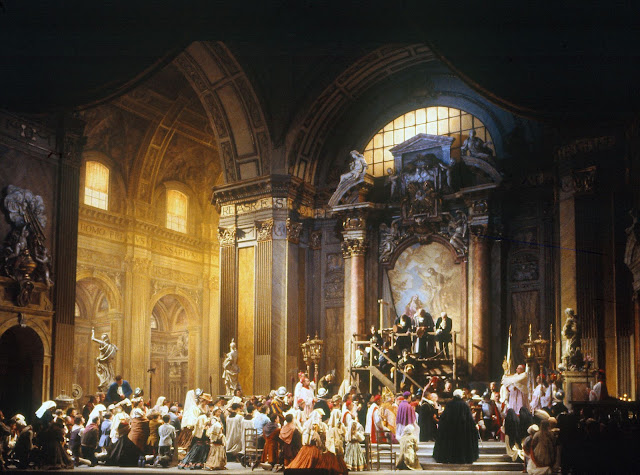
In an  interview  last month, David McVicar, the director of the Metropolitan Opera's new production of Tosca , talked about how, when talking about productions of operas, people confuse "traditional" with "period." Peter Gelb took over as the Met's general manager in 2006, and since then, most of the company's standard repertory has been replaced with new productions, most of which in turn could be said to be "non-traditional." In general, productions can be non-traditional in one of two ways. They can either be set in a time or place apart from what the libretto specifies, or the choices made could be more artistic, with unrealistic sets and stylized costumes and whatnot. It's easy to spot a non-period production simply by looking for anachronisms. And the Met's had their share, from Michael Mayer's infamous Vegas-set Rigoletto , to ones that more or less flew under the radar, like Deborah Warner's Eugene Onegin,  or Richa...